
Cornute From Ferguson: The Death of Michael Brown


FERGUSON, MO— A police officer involved shooting in Ferguson, Missouri sends shock waves around the world. In a matter of hours the international spotlight hits Ferguson with precision. The death of 18 year old Michael Brown becomes front page news from Missouri to London to Tibet. It is a story that captures the attention of local, national and international media. It quickly becomes clear that I, like other Journalists, face the biggest story St. Louis has seen since the kidnapping of Charles Lindberg’s baby. Some people might challenge the comparison. But I think I’m right.
I’m a Reporter for KTVI-TV in St. Louis. I have spent the past thirty years covering homicides, fires, state and local politics, education, the arts, health and now consumer issues. Covering Michael Brown’s death is a story with many variables. It wasn’t just another shooting. Sadly, gun violence is a frequent topic in our newscasts. But when Ferguson Police Officer Darren Wilson saw Michael Brown and Brown’s friend Dorian Johnson walking in the middle of the street on a Saturday afternoon none of us could have predicted that life ending encounter would draw intense scrutiny from the media and the public at large.
The national spotlight brought out network correspondents like Anderson Cooper. I got a chance to visit a couple of times at “ground zero” with my former colleague Don Lemon. He used to work with me at KTVI. I met reporters from the Los Angeles Times, The Washington Post, NPR, Fox News, Al Jazeera TV, Netherlands TV to name a few. Some Journalists felt police roughed them up or arrested reporters because somehow the media was responsible for the negative image of St. Louis and the region presented to the rest of the world.
In the days following the shooting it was “all hands on deck” for local media outlets. Everyone was involved. For two solid weeks our daily editorial meetings were filled with discussion about the various angles that needed to be covered. There were police news conferences, family news conferences, the emergence of “new witnesses”, the looters, the clean-up, the marchers, the prayer vigils, the County Grand Jury convenes, the U.S. Justice Department investigation, a visit from retiring United States Attorney General Eric Holder, the Governor sending in the National Guard, the arrest of journalists, the autopsy reports, video from a convenience store strong armed robbery allegedly involving Michael Brown, the call to get the County Prosecutor to recuse himself, the military style response to protesters, the tear gas, the stop the violence concerts, the mere presence of Rev. Al Sharpton, Rev. Jesse Jackson, TV Personality & empowerment legend Iyanla Vanzant, Reality TV star Benzino, filmmaker Spike Lee and of course the funeral.
As reporters and producers working a big story we search for the latest development to include in our reports. We devote a lot of time trying to be first covering a specific angle. I tried without success to get an interview with Michael Brown’s mother Lesley McSpadden. A friend of mine is a distant cousin. She tried to hook it up for me. But the family’s attorneys Benjamin Crump from Atlanta and Anthony Gray from St. Louis seemed more interested in making the parents available to national media and not local media. I understand. The national media gives them a bigger stage. I’ve seen that before. Not to worry. There were enough related issues to cover. I worked ten hour days for two weeks. I worked six days straight the first week.
Michael died around 2:15pm on August 9th, a Saturday. His body lay in the street for almost four hours. There was no orange screen put in place to conceal the body as investigators gathered forensic evidence. That’s what I usually see when covering a homicide. But in this case the lifeless body of an unarmed teenager lay in the street while family looked on in horror. Residents of the Canfield Green Apartments poured into the streets looking for answers. Tension was building. By Sunday they responded by holding a Prayer Vigil. Soon after it ended the energy changed from shock, to sadness, to anger. The businesses along West Florissant Ave. became targets. Looters took aim at the tire store, the beauty supply store, the cell phone retailer, the meat market, the Quick Trip gas station, the Dollar Store, the sporting goods store, the convenience mart, the Chinese carry out and the shoe store. By the time the Sunday evening news came on at 6:00pm it was the ONLY story. By 9:00pm we were covering the looting LIVE. And we provided uninterrupted coverage until about 2:00am.
Mind you I don’t work weekends so Sunday I was home watching the continuous coverage. As I watched, I mentally went back to Michael’s death a few hours earlier. I actually remember thinking Saturday night…..This is going to get ugly. It was just so obvious watching Saturday’s news that there was anger and disbelief about the shooting of an unarmed teenager. I thought, people are not going to stand for this. And then a vision of looting crossed my mind. I don’t know why that was such a strong premonition. But I’ll never forget how clear it was.
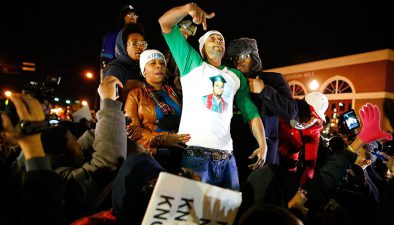
Monday morning rolls around and I’m assigned to cover the first big prayer vigil at Murchison Tabernacle CME Church, not far from Ferguson. Hundreds showed up. I saw parents with small children, working adults, grandparents, college students, clergy and some business owners. This was the more conservative crowd. But they too were fired up. The space was not large enough to accommodate everyone. A hundred or so stood outside and shared words of encouragement and called for the arrest of Darren Wilson. I did live shots at 5pm, 6pm and 7pm. As soon as the producer cleared us following the 7pm live shot, my cameraman and I were told to head over to “ground zero” where protestors were physically confronting police. “Ground zero” is the term that people started using to describe the business district on West Florissant Ave. less than a block from Canfield Green Apartments.
It was dark when we got there. But the street was bright with flood lights from police vehicles. And there were the typical flashing red and blue lights from police cars. I could see what I thought was smoke in the air. As we got closer I could tell it was not just smoke. It had a chemical smell. But there was no irritation like you’d expect from tear gas. A line of armored police vehicles with officers in riot gear faced a small group of young people in the middle of the street. An officer using a loudspeaker was telling everyone to “Clear the street” or “Return to your homes”. Three young men walk within a few yards of the police line, arms extended in the air as a sign of surrender. They kneel down. A tear gas canister hits the ground near the young men. One of them picks up the canister and tosses it back toward police. Then the young men scatter. My cameramen, along with media crews from other outlets are recording this from the sidewalk. Then the next request from police is for reporters to leave the area. We didn’t move right away. We continued recording as officers fired rubber bullets at someone running between houses. My cameraman and I happened to be the closest to this incident. Then the flood light on the armored vehicle is aimed right at the two of us. For a moment I thought, are they going to shoot tear gas or bullets at us? A few seconds passed and they directed their attention again to the young men darting in and out of walkways between homes. I couldn’t tell if the young people where throwing things at the police or just yelling at them. There was just a lot of noise. But it wasn’t long before Casey Nolen a reporter from a different local TV station comes over and says, “Bonita, they want us to leave. What are you going to do? It feels unsafe.” So I said, ok let’s go. I tapped my cameraman who scooped up the camera and tripod. As we quickly walk toward our car the sound of police firing rubber bullets get louder. Then a tear gas canister hits the ground near us. As soon as I opened the car door I began coughing. My eyes were burning a little. I grabbed the bottle of water I had and swallowed quickly. I just kept my eyes closed and the irritation went away. If I had not gotten into the car when I did, I’m sure that the effect would have been bad. As we drove away, I couldn’t help but think they knew we were leaving. There were no teens around us as we were leaving. They didn’t need to shoot the tear gas in our direction. I wondered if we were targeted for being there documenting what was happening.
We pulled back about two blocks from the police line. I saw two of the young men who knelt in front of police. I had to interview them. Why were they willing to risk getting hurt? Why didn’t they disperse when instructed to leave? I wasn’t surprised by their answers. They talked about being stopped by police for no reason. They’re told they have a warrant. The next step is police lock them up. Hours later they’re released and told it’s a mistake. There is no warrant. One of the young men says this happened to him more than once. He eventually lost his job because he was locked up so much. They explained how frustrating it is to be stopped while driving for no clear violation. This happens more often than most white motorist can begin to understand.
The state of Missouri Attorney General’s Office actually gathers statistics on racial profiling by police. It’s broken down by municipality. Ferguson has 53 commissioned police officers. Only three are black, a number that does not reflect the racial makeup of the city. Ferguson’s population is two thirds African American and one third Caucasian. Looking at 2013 statistics for traffic stops resulting in arrests in Ferguson black motorists have reason to be concerned. Of the 5,384 traffic stops 676 were white drivers and 4,632 were black. Police officers conducted 611 searches…..47 on white people, 562 on blacks. When it comes to arrests after a traffic stop, there were a total of 521 in Ferguson last year. 36 were white people while 483 blacks were arrested. When you boil the numbers down Blacks accounted for 93-percent of arrests after traffic stops, 92-percent of searches and 80-percent of traffic stops in Ferguson.
The unemployment rate is extremely high as is the High School dropout rate for blacks living in Ferguson. Many have spoken about a sense of helplessness. And there’s a deeply rooted frustration knowing this treatment is racially motivated. Jamala Rogers a columnist with the African American weekly, The St. Louis American says before the shooting of Michael Brown, “There were pre-existing divisions that have either been allowed to fester or half-heartedly addressed.” The divisions are reflected in police-community relations. One officer from a neighboring suburban police force was fired after a FACEBOOK post that said, “The protestors should have been put down like a rabid dog the first night.”
There appears to be a generational division between middle age African Americans and young people under 25. The young men I interviewed suggested that they would fight to the bitter end. Yes, they told me they’re willing to die. They are fed up and they don’t like the idea of waiting for the system to work for them. It has failed them miserably. It was scary to look into their faces and not see them flinch when they talked about dying. It was so matter of fact.
This is why there were daily protests somewhere in Metropolitan St. Louis through October. Street marchers gathered every day on West Florissant Ave. Another group would march in front of the Police station about a mile away from “ground zero.” On one occasion a group attempted to stop rush hour traffic on busy Interstate 70. They were removed peacefully before they could get down the entrance ramp to the highway. Elder Bernice King, daughter of Rev. Dr. Martin Luther King Jr. has visited with schools in the area talking about nonviolence and how the children should cope with the violence. Other days a different group might be at the County Justice Center in Clayton to protest the role of the County Prosecutor Bob McCulloch and the Grand Jury his office convened to determine if Officer Wilson will stand trial. Some African Americans have very strong feelings about the prosecutor’s ability to be impartial. When he was 12 years old, the Prosecutor’s father, St. Louis police officer Paul McCulloch, was killed during a shoot-out with a black kidnapping suspect. And there’s no doubt law enforcement runs in the family. In addition to his father, McCulloch’s brother, nephew and cousin all worked for police departments. His mother was a clerk for one of the departments.
In some ways you might say the protests and the international media attention has forced people to wake up. Groups are talking.
- The clergy is involved organizing interfaith conversations about influencing change.
- A monthly dialogue calling itself Mother to Mother brings white and black mothers together to discuss concerns about raising children in a racially volatile community.
- Missouri development officials at the urging of the Governor have come up with money to help rebuild small businesses hit by looters.
- The Urban League of Metropolitan St. Louis held a Jobs Fair one Saturday morning in Sept. and it’s reported over 5, 000 people showed up looking for work.
- Centene Corp. a Managed Care Company promises to build a new claims office in Ferguson. That will create 200 new jobs.
- The Deaconess Foundation for Health has allocated one hundred thousand dollars for leadership training and jobs for young people. The director actually admits it was the grass roots youth leaders that gave voice to the need for action on the critical matters of race and power.
- Voter registration booths are strategically placed in retail areas throughout St. Louis County. The local branch of the NAACP recognizes there is a large group of African Americans who don’t understand the political process.
Would any of this have happened within a two month time period had it not been for the shooting of Michael Brown? I’m sure the answer is no. It’s truly surreal when I read some of the things Michael said before he died.
But first who is Michael. He was a big kid. He recently graduated from Normandy High School. He was enrolled at Vatterot College a trade school for engineering. He also dreamed of a music career. He didn’t always do well in school. His mother and father both talk about the struggle they met trying to keep him focused so that he could graduate. Now the family mourns his passing. They have been through a lot over the past three months. For weeks after the shooting they waited for three autopsies. Once by the St. Louis County Medical Examiner, once by a Pathologist hired by Brown’s family and the third by federal authorities in conjunction with the U.S. Justice Dept. Investigation.
It seems Michael knew something was going to happen. He told a friend, days before the shooting, that “he was feeling some bad vibes”. The feeling wouldn’t go away. He told his step mother something similar the week before his death. During the funeral Calvina Brown told the congregation that Michael told her that one day he would shape the world. That one day the world would know his name.
The morning of the shooting Michael stopped and talked to 2 utility workers installing in-ground lines. They say it was a friendly rambling kind of conversation that lasted about thirty minutes. It all started when Michael heard the worker curse after hitting a tree root while digging. It must have resonated with Michael because the worker says Brown “told me he was feeling some bad vibes.” Michael continued saying “The Lord Jesus Christ would help me through that as long as I didn’t get all angry at what I was doing.” About half an hour later the workers heard gunshots. They looked and saw Brown running away from the police car. By the workers’ account, Officer Wilson trailed about 10 to 15 feet behind. The gun was in his hand.
Now what happens? There have been threats from some who say the Grand Jury must indict Officer Wilson. If there is no indictment the Metropolitan area will be caught in the middle of a very ugly and violent situation. The schools in the area near Ferguson are already asking for a “heads-up” from the Prosecutor so children can be dismissed early and out of harm’s way getting home from school. Some businesses are already ordering wood and they are covering their glass storefronts.
Whether you live in Ferguson, Chicago, Dayton, Columbus, Atlanta, Brooklyn, Oakland, Seattle, Miami, Denver, Dallas, Los Angeles or St. Louis, BLACK LIFE MATTERS. It’s up to us to make sure that public policy is there to protect us. It’s also important that we work to combat black on black crime. If we don’t value black life why should others? And never forget where you come from. It’s easy to see your success as a measure for others to achieve. But sometimes we have to reach back and make sure we haven’t dropped a few precious lives along the way.
RIP Michael Brown and all the young lives lost to violence…..whether it be at the hands of police or our own kin.