Ferguson Revisited: Is The City Ready For Change




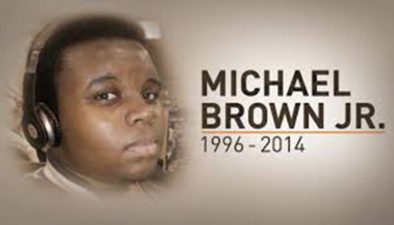
FERGUSON, MO—Fourteen months ago intense international attention was focused on Ferguson, MO. A young man was dead and a police officer shot him. That’s a formula for grief, drama, confusion, power plays and denial. Fourteen months ago no one knew how the family of Michael Brown Jr. would begin to heal following his emotionally charged death at the hands of former Ferguson Police Officer Darren Wilson. No one really knew what it would take to begin rebuilding fractured relations and end systemic bias in Ferguson and the surrounding communities.
Back in the present. I’m toying with how best to update you. A lot has happened since Brown’s tragic death August 9, 2014. But some things remain the same. Laws have changed but the attitudes of some have not. The Ferguson Police, as do many others in law enforcement, now wear mandatory body cameras. Missouri municipal courts have made significant improvements. Commissions were formed leading to corporate response in the form of multi-million dollar donations. But sometimes it feels like it will be another five years before measurable, sustainable benefits will be noticed. And those who sympathize with the Brown family’s loss say black lives don’t matter.
On November 24, 2014 the world was told that the St. Louis County Grand Jury determined there was no probable cause to prosecute Darren Wilson. He had not committed a crime. Over a 3 month period the Grand Jury met 25 times and heard 70 hours of testimony given by at least 60 witnesses. Observers and critics say the Grand Jury process in this case was a peculiar move on the part of the Prosecuting Attorney. Peculiar is one thing. Protesters saw it as a horrible refusal to understand the need to punish someone after a life was taken.
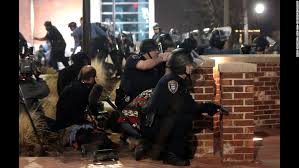
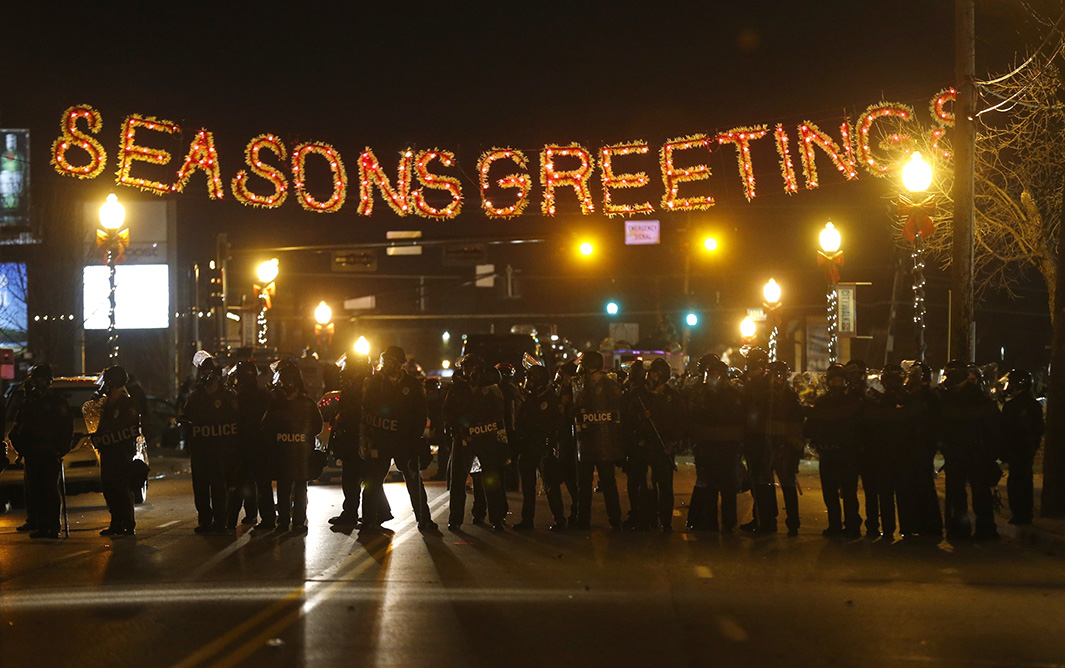
I was on the team that worked the night the Grand Jury announcement was made. Reporters and Photographers were given gas masks and bullet proof vests. We were assigned 3 private security guards. The guy I worked with has worked private security for US officials in the Middle East. He was always close and kept a close eye on the crowd’s mood. That was critical because we stood just feet away from hundreds of protestors who filled the street waiting for the Grand Jury Announcement. When Prosecutor Bob McCulloch was ready to announce it “live” on TV an eerie, stillness came over the crowd standing in the cold night air. People were listening to the live broadcast on their cell phones. McCulloch took a lot of time to “set up” the announcement. We learned what jurors looked at, whose testimony they heard…and on and on and on. Finally he said it. NO INDICTMENT.
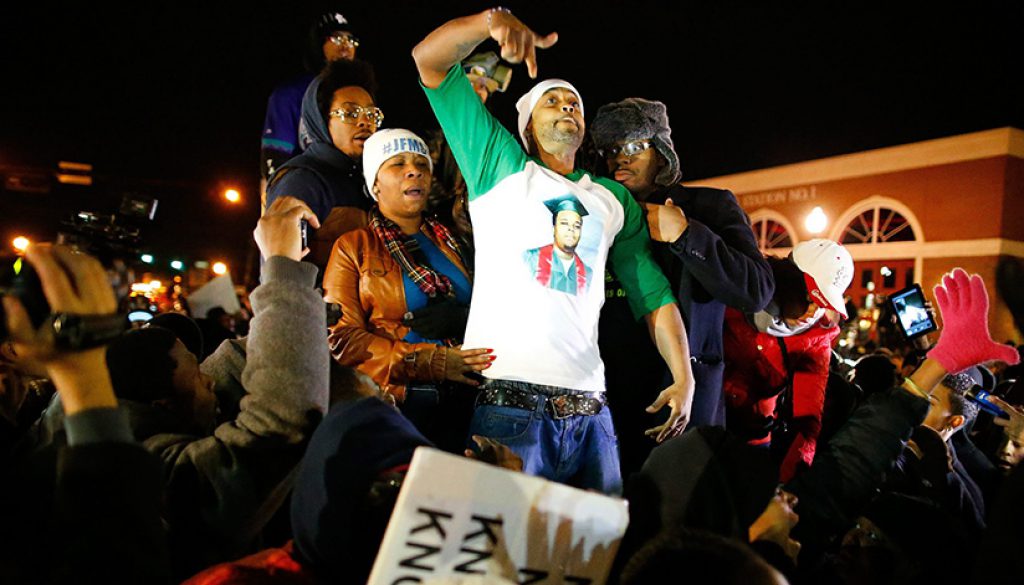
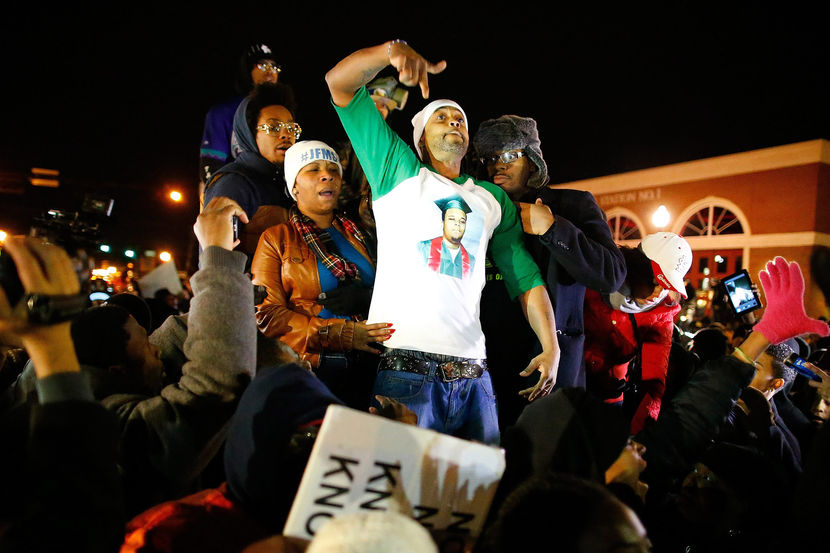
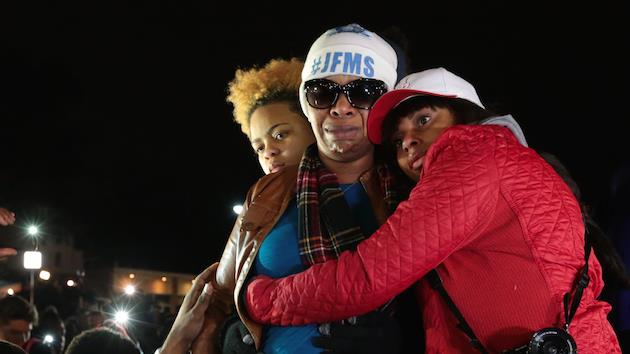
Cameras captured Leslie McSpadden, Micheal Brown’s mother standing on the hood of a car above the crowd reacting to the news. She’s crying. Her husband is cussing. The crowd wasn’t quiet anymore. People were moving……pushing forward toward the police line in front of the Ferguson Police Department. After a few minutes of face to face taunting people started running. Needless to say the security guys with our TV crew pulled us back. We were all heading toward our vehicle a block away when gunshots were fired. This is also the night when vehicles are set on fire, stores looted and buildings burned. Calm is restored over the next 24 to 48 hours. In an effort to stop the violence, Michael’s parents issued this statement.
“We are profoundly disappointed that the killer of our child will not face the consequence of his actions.
While we understand that many others share our pain, we ask that you channel your frustration in ways that will make a positive change. We need to work together to fix the system that allowed this to happen.
Join with us in our campaign to ensure that every police officer working the streets in this country wears a body camera.
We respectfully ask that you please keep your protests peaceful. Answering violence with violence is not the appropriate reaction.
Let’s not just make noise, let’s make a difference.”
Lesley McSpadden and Michael Brown, Sr.
Parents of Michael Brown, Jr.
At this point Brown’s family and supporters are looking to the US Justice Department’s two ongoing investigations. Surely these federal probes will bring the justice they’re looking for.
It’s now the end of November 2014 and the Ferguson Commission is well into its assigned task of “studying the underlying issues raised by events in Ferguson and to present a report with specific policy recommendations no later than Sept. 15, 2015.” Gov. Jay Nixon appointed a diverse group of St. Louis area residents to the Ferguson Commission. Over 300 people applied 16 were selected. They met and crafted policy recommendations that address the need for Municipal Court Reform, Citizen-Law Enforcement relations, Child Well-being and Education Equity, Economic Inequity and Opportunity, Racial Equity and Reconciliation among other things.
As March 2015 approaches peaceful protests continue on West Florissant Avenue in Ferguson, at the County Courthouse in Clayton and the Federal Courthouse in downtown St. Louis. People on both sides are waiting for the US Justice Department findings. Finally near the end of February, we were reporting “leaked information indicating there was not enough evidence to prosecute former Officer Darren Wilson. Protesters and the Brown Family cried foul. First because the sanctity of the process is questionable if there are leaks. Secondly, if true, for some it proves the system treats blacks unfairly because an unarmed black teen is dead.
On March 4, 2015 the first announcement came following months of investigating The Shooting Death of Michael Brown by Ferguson Missouri Police Officer Darren Wilson. It found no probable cause to prosecute. Evidence reviewed by FBI investigators indicate Michael Brown Jr. struggled with Wilson over his gun as the Officer sat in his police vehicle. As Wilson told the Grand Jury, he told the FBI his life was in danger. The assumption is the gun was initially discharged during that encounter and additional shots including the fatal shots were fired after Wilson exited the vehicle. Bad news for the Brown family.
The same day, the US Justice Department reported its findings in the investigation of the Ferguson Police Department and the City of Ferguson. It was much more in line with what the Brown Family and protesters wanted to hear. It made the city and its police look very bad saying, “In nearly every aspect of Ferguson’s law enforcement system” African Americans are disproportionately impacted.
The report goes on to describe a system that survives on the practice of using arrest warrants to squeeze money from taxpayers and other practices shaped “by revenue rather than by public safety needs.” It found that 67% of African Americans in Ferguson account for 93% of arrests made between 2012 and 2014. The report indicates the use of force by officers, in some arrests, stemmed from unlawful bias. The Canine Unit’s reports of dog bite incidents all involved black people. Jail time was a possibility for missed, late or partial payment of a fine. A significant portion of the city’s revenue was generated by court fines and warrants and more court fines.
US Attorneys describe it as “conduct that routinely violates the Constitution and federal laws.”
The scathing report began a wave of personnel changes in Ferguson city government.
- March 4 —Mary Ann Twitty, Municipal Court Clerk fired for sending racist emails.
- March 5 —Rick Henke, Police Capt. resigns
- March 5 —William Mudd, Police Sgt. resigns
- March 9 —Ronald Brockmeyer, Municipal Court Judge resigns
- March 10 —John Shaw, City Manager resigns
- March 11 —Thomas Jackson, Police Chief resigns
With so many changes, the Missouri State Supreme Court stepped in March 6, 2015. The Court announced it would take the “extraordinary action” of reassigning to the circuit court all Ferguson municipal court cases. It was two months after this move that a replacement was named to hear Municipal cases. He is retired Missouri Appeals Court Judge Donald McCullin, an African American.
The Brown family files a Wrongful Death lawsuit in Federal Court in April 2015. To the family’s disappointment, the Judge dismisses four of the six counts. Attorneys will move forward on two counts.
Around the same time the Missouri Legislature begins crafting a bill intended to reform Municipal Courts statewide. Call it the Ferguson Effect. But with the spotlight shining on the city by the feds, something had to be done. A key provision of the law is reducing from 30% to 20% the annual amount of operating revenue a municipality can generate from traffic fines. The bill was signed the Governor in early July 2015. This along with the appointment of a black Municipal Court Judge, a black Police Chief and the election of three blacks to the city council made people throughout the region began to feel the stress ease a little.
Now its August 9, 2015, the anniversary of Michael Brown’s death. For the most part peaceful protests and street celebrations marked the transition of the young man. By nightfall the protests turned violent with arrests and some looting. Despite small flare ups, the protests faded over the next couple of days.
The US Justice Department also looked at the St. Louis County Police Department and it’s handling of the 2014 disturbances. Two reports were released with findings that address tactical strength versus community policing skills. They were made public in September 2015.
By Sept. 15, 2015 the Ferguson Commission was ready to release its report. Remember this is the state body appointed the year before to come up with policy recommendations. They completed the work on schedule producing a 200 page document titled “FORWARD THROUGH FERGUSON: A Path Toward Racial Equity”. The Commission’s report lists 189 Calls to Action. These include, Reforming School Discipline Policies, Expanding Internship and Apprenticeship Opportunities, Enhance College Access and Affordability, Engage in Better Community Policing, Develop a Comprehensive Demonstration Response Plan to name a few. The report is impressive. It covers most everything the Commission considered when developing the Calls to Action. To be a viable road-map for change, there must be an infusion of capital to put the programs in place that address problems. Major donors have come forward to help with some things.
Emerson Electric is a global manufacturing and technology company. It operates on a sprawling campus on the north eastern edge of Ferguson. The Fortune 500 Company planted its roots in Ferguson at a time when it had less than a 1% black population. Today blacks are 70% of the population. So now that the flames appear to be squashed, it’s interesting to note that Emerson’s commitment to improving the area is represented by an 8.5 million dollar donation over the past few months. So far pledges and expenditures have been used by the Ferguson Florissant School District for the Head Start Program. Youth Jobs Programs have been funded by Emerson. Four million dollars has been set aside for scholarships for students attending private high schools and three state universities in the area. And two million is pledged to help build the Urban League’s job training and placement program.
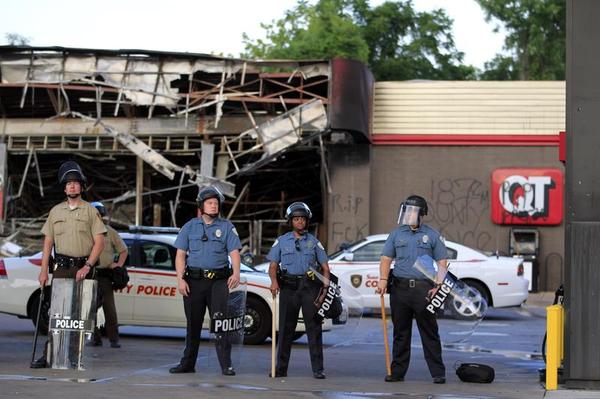
The Urban League plans to build a new structure on the land once owned by the Quick Trip Gas stations. The station was destroyed in the first night of looting following Michael Brown’s death. Quick Trip donated the land and removed the underground gas tanks. Other corporate and state leaders are donating another three million to get a new building constructed. The goal is to bring 500 African American males through the program guaranteeing they are ready to work and take care of themselves and their families. Many of them are hardcore unemployed, unmarried fathers and high school dropouts.
Another major donor Ameren Electric, is the region’s electric utility company. This company is giving 2.5 million dollars in response to the Ferguson Commission Report. The money will be used for 7 different programs and initiatives. They include educational opportunities, job readiness programs, internships, mentoring and utility assistance.
So, chronologically this brings you up to date on the highlights of events in Ferguson Missouri over the past year. It’s been a rough ride. It’s not over yet. The problems are not perfectly cleaned up yet. Just last month, during an observatory visit to the Ferguson Municipal Court most of those summoned to court were African American. Crime continues to be a problem. A child is shot while doing her homework. A stray bullet shatters the bedroom window striking and killing the little girl. Her house is less than a block from the entrance to the apartment complex where Michael Brown died. At least three black males have been shot and killed near the complex as well. The assailants in these cases were other black males. You might say the million dollar donations came too late to make a difference in the lives of these young people.
And clearly there are inequities that continue to go unnoticed and unchecked. In digging through all of the material I’ve been collecting since Michael Brown’s death I came across a newspaper article that I forgot about and that few people probably noticed.
The Ferguson incident is not the only issue that drew the attention of the US Justice Department. Long before Michael Brown Jr. and Darren Wilson crossed paths, federal investigators were looking at the St. Louis County Family Court. This body handles all juvenile justice cases for children living in the 82 municipalities that make up the county and border the city of St. Louis. The feds started that probe in 2013. After looking at cases resolved by the court between 2010 and 2013, the Justice Department says “We find the St. Louis County Family Court violates the due process rights of children facing delinquency proceedings.”
Many children languish in the system waiting for a Public Defender to represent them. A single Public Defender handles a staggering caseload. Juveniles facing certification as an adult for pending charges fail to receive due process according to the report. A huge conflict of interest exists because probation officers also serve as child advocates. And most disturbing, black youth are disproportionately charged formally versus handling matters informally. They are detained pretrial when facing charges. Black children are almost three times more likely to be committed to out-of-home settings then white children. And when white children are committed to Division of Youth Services custody, they are placed in a less restrictive setting such as probation with in-home services or in a non-state run residential treatment facility.
This didn’t get talked about much at all when it came out. Perhaps because the release was the week before the anniversary of Brown’s death. As I think back on it, the media and police and government were bracing for more unrest on the anniversary. I think this got kicked to curb unfortunately. It ties in very closely with the lack of hope that some of the young people were screaming about last summer. Some of the kids who lived in Ferguson and got caught up with the wrong circle or whose parents simply couldn’t provide for them, or who have been failed by the schools from first grade through high school, may have been forced into the Juvenile Justice system that flourished at the St. Louis County Family Court. And then they get out and go back to the same oppressive, non-supportive environment in that community. Makes you wonder how any black child living in poverty can survive living life like that.
I’m watching closely and asking questions about planning and implementing change for this region. It really hurts to think that, had Michael Brown not been shot, it would be business as usual in St. Louis County. His death makes us pay attention to the many senseless deaths of African Americans in cities all across this country.
But I’m also paying close attention to just how much damage we do to ourselves. How much work we still have to do on ourselves to build the coalitions necessary to demand change. I’m watching just how little respect we allow our girls to have for their bodies. I’m paying attention to just how quickly our boys resolve disputes with a gun. I’m watching mothers party more than their kids. But I’m smiling when I see men step up despite the lack of funds and do their very best to be loving fathers to their children.
I’m praying that it’s not five years before we see major tangible benefits from this broad push to clean up the Ferguson mess. I’m praying that this family looks for ways to overcome obstacles, trials, disagreements and fear. I’m praying that joy fills the hearts of everyone reading this. I’ve seen the despair that comes when there’s no joy. I don’t like it and I know you don’t either.
All of the reports referenced in this piece are available online to download if anyone is interested in a deeper look at this complex story.